
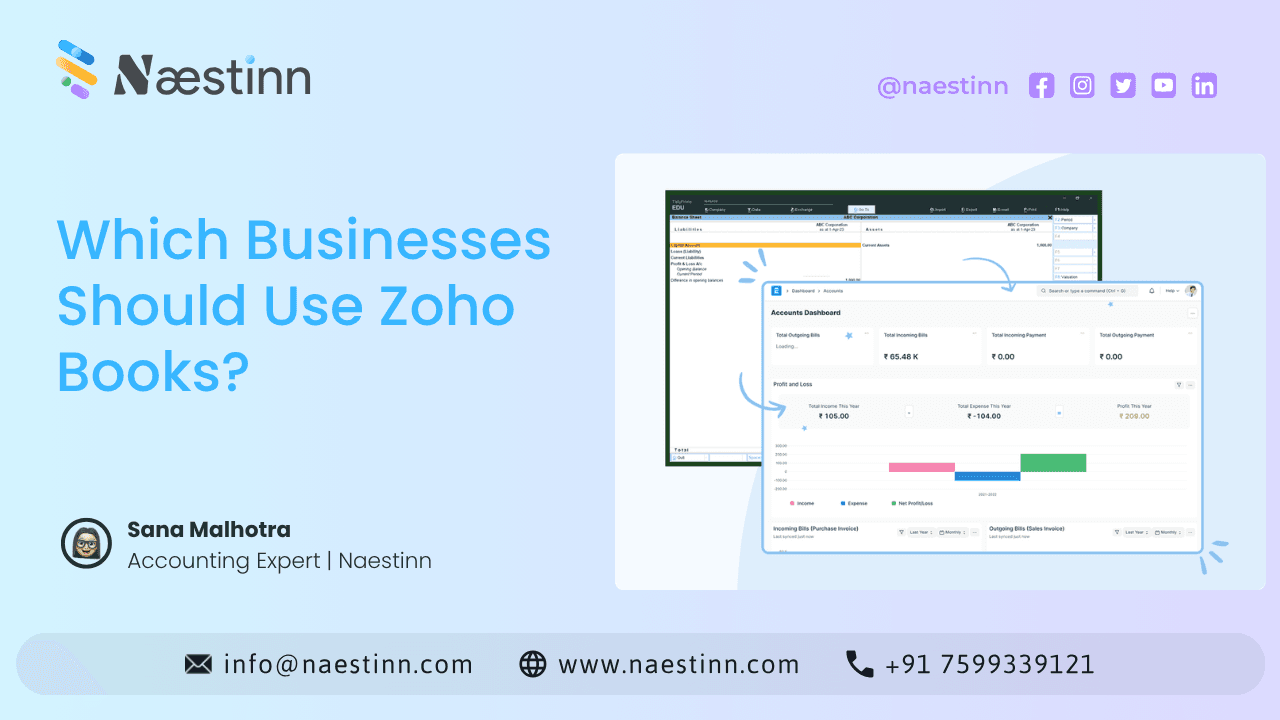
Managing finances efficiently is essential for every growing business. From creating invoices and tracking expenses to managing taxes and monitoring cash flow, accounting can quickly become complicated as a company grows.
Many businesses still rely on spreadsheets or traditional accounting software, which can make financial management time-consuming and difficult to scale.
Zoho Books is cloud-based accounting software designed to help businesses manage their finances, automate accounting processes, create invoices, track expenses, manage customers and vendors, and gain better visibility into their financial performance.
But is Zoho Books right for every business?
Not necessarily.
In this guide, we'll look at which types of businesses can benefit most from Zoho Books and how it can help simplify everyday accounting operations.
What Is Zoho Books?
Zoho Books is an online accounting platform that helps businesses manage core financial activities from a centralized system.
Depending on the business's requirements and plan, it can support activities such as:
-
Invoicing
-
Expense management
-
Accounts receivable and payable
-
Bank reconciliation
-
Inventory management
-
Tax management
-
Financial reporting
-
Customer and vendor management
-
Online payments
-
Business automation
Because it is cloud-based, businesses can access their financial information from anywhere with an internet connection.
1. Small and Medium-Sized Businesses
Small and medium-sized businesses are among the strongest use cases for Zoho Books.
Growing businesses often need more than spreadsheets but may not want the complexity of larger enterprise accounting systems.
Zoho Books can help SMEs:
-
Create professional invoices
-
Track expenses
-
Monitor receivables
-
Manage vendors
-
Reconcile bank transactions
-
Generate financial reports
-
Automate repetitive accounting tasks
This gives business owners better financial visibility without requiring a complicated accounting setup.
2. Startups
Startups need accounting systems that can grow alongside the business.
Zoho Books can help startups establish structured financial processes from the beginning.
For example, startups can use it to manage:
-
Customer invoices
-
Business expenses
-
Vendor payments
-
Cash flow
-
Recurring invoices
-
Financial reports
As the company grows, additional integrations and automation can be introduced to support more complex processes.
3. Service-Based Businesses
Businesses that sell services rather than physical products can benefit significantly from streamlined invoicing and expense management.
Examples include:
-
IT companies
-
Digital marketing agencies
-
Consulting firms
-
Software companies
-
Recruitment agencies
-
Professional service providers
These businesses can use Zoho Books to create invoices, track customer payments, manage expenses, and monitor their financial performance.
4. Freelancers and Consultants
Freelancers and independent consultants often manage accounting themselves.
Instead of maintaining multiple spreadsheets, they can use Zoho Books to organize:
-
Client invoices
-
Expenses
-
Payments
-
Recurring billing
-
Tax-related records
-
Financial reports
This reduces administrative work and gives independent professionals a clearer view of their finances.
5. Retail Businesses
Retail businesses deal with a large number of transactions, customers, vendors, and inventory items.
Zoho Books can help retailers manage:
-
Sales invoices
-
Purchases
-
Inventory
-
Vendors
-
Expenses
-
Payments
-
Financial reports
It can also integrate with other business applications to create a more connected retail operation.
6. E-commerce Businesses
Online businesses often use multiple platforms for selling, payments, inventory, and customer management.
This can create disconnected financial data.
Zoho Books can help e-commerce businesses centralize financial information and manage:
-
Online orders
-
Customer invoices
-
Expenses
-
Payments
-
Inventory
-
Tax-related transactions
-
Financial reporting
Integrations with e-commerce and payment platforms can further reduce manual data entry.
7. Manufacturing Businesses
Manufacturing companies have more complex financial and operational requirements than many service businesses.
They need visibility into:
-
Purchases
-
Vendors
-
Inventory
-
Expenses
-
Sales
-
Receivables
-
Payables
Zoho Books can support financial management while integrating with other applications where additional manufacturing functionality is required.
8. Wholesale and Distribution Businesses
Wholesalers and distributors manage large volumes of purchases, sales, customers, and vendors.
Zoho Books can help businesses:
-
Create quotations and invoices
-
Manage customer accounts
-
Track vendor transactions
-
Monitor receivables
-
Manage inventory
-
Generate financial reports
This can make financial operations more organized as transaction volumes increase.
9. Educational and Training Businesses
Coaching institutes, training companies, and educational service providers can use Zoho Books to manage their financial operations.
They can use it for:
-
Student/customer billing
-
Recurring invoices
-
Expense tracking
-
Payment monitoring
-
Vendor management
-
Financial reporting
10. Travel and Hospitality Businesses
Travel agencies and hospitality businesses often manage multiple vendors, customer payments, and transactions.
Zoho Books can help them organize:
-
Customer invoices
-
Vendor payments
-
Business expenses
-
Receivables
-
Financial reports
For businesses that already use other Zoho applications, integrations can create a more connected business ecosystem.
11. Businesses That Want to Automate Accounting
If your accounting team spends significant time performing repetitive tasks, automation can make a major difference.
Businesses can automate processes such as:
-
Recurring invoices
-
Payment reminders
-
Expense workflows
-
Transaction notifications
-
Approval processes
-
Bank reconciliation workflows
This allows finance teams to spend more time on analysis and decision-making rather than repetitive administration.
12. Businesses Already Using Zoho Applications
One of the biggest advantages for businesses already within the Zoho ecosystem is integration.
For example, a business using Zoho CRM can connect its customer and sales processes with its accounting operations through Zoho's ecosystem.
This can help reduce duplicate data entry and create better visibility between sales and finance teams.
Who Should Consider Zoho Books?
Zoho Books may be a good fit if your business:
✅ Is growing beyond spreadsheets
✅ Needs professional invoicing
✅ Wants cloud-based accounting
✅ Needs better expense tracking
✅ Wants to automate repetitive accounting tasks
✅ Needs financial reports and dashboards
✅ Wants to connect accounting with other business applications
✅ Needs a scalable accounting solution
Who May Need Something More Specialized?
Zoho Books isn't necessarily the right standalone solution for every organization.
Businesses with highly specialized accounting, industry-specific, or large-scale enterprise requirements may need additional software or integrations.
Before implementing any accounting platform, it's important to evaluate your:
-
Business size
-
Number of transactions
-
Accounting processes
-
Industry requirements
-
Inventory complexity
-
Integration requirements
-
Reporting needs
-
Compliance requirements
How Naestinn Can Help With Zoho Books
Choosing accounting software is only the first step. The way it is configured and integrated with your existing processes can significantly impact its effectiveness.
Naestinn helps businesses implement and optimize Zoho Books according to their specific requirements.
Our services include:
-
Zoho Books consultation
-
Zoho Books implementation
-
Accounting workflow automation
-
Data migration
-
Customization
-
Zoho CRM–Zoho Books integration
-
Third-party integrations
-
User training
-
Ongoing support
We help businesses move from disconnected accounting processes to a more structured and automated financial workflow.
Final Thoughts
Zoho Books can be a strong accounting solution for startups, SMEs, service businesses, freelancers, retailers, e-commerce companies, wholesalers, distributors, and other growing businesses.
The biggest benefit isn't simply having accounting software—it's having a centralized system that can reduce manual work, improve financial visibility, and connect accounting with other areas of your business.
If you're considering moving from spreadsheets, upgrading your existing accounting software, or connecting your accounting and sales processes, Naestinn can help you evaluate and implement Zoho Books based on your business requirements.
Ready to streamline your accounting?
Talk to Naestinn's Zoho Books experts and discover how Zoho Books can fit your business.
Frequently Asked Questions
Is Zoho Books suitable for small businesses?
Top Stories

Turn your vision into
scalable reality.
Stop guessing with AI-generated scopes. Get reliable architecture, expert engineering, and a product that scales.