
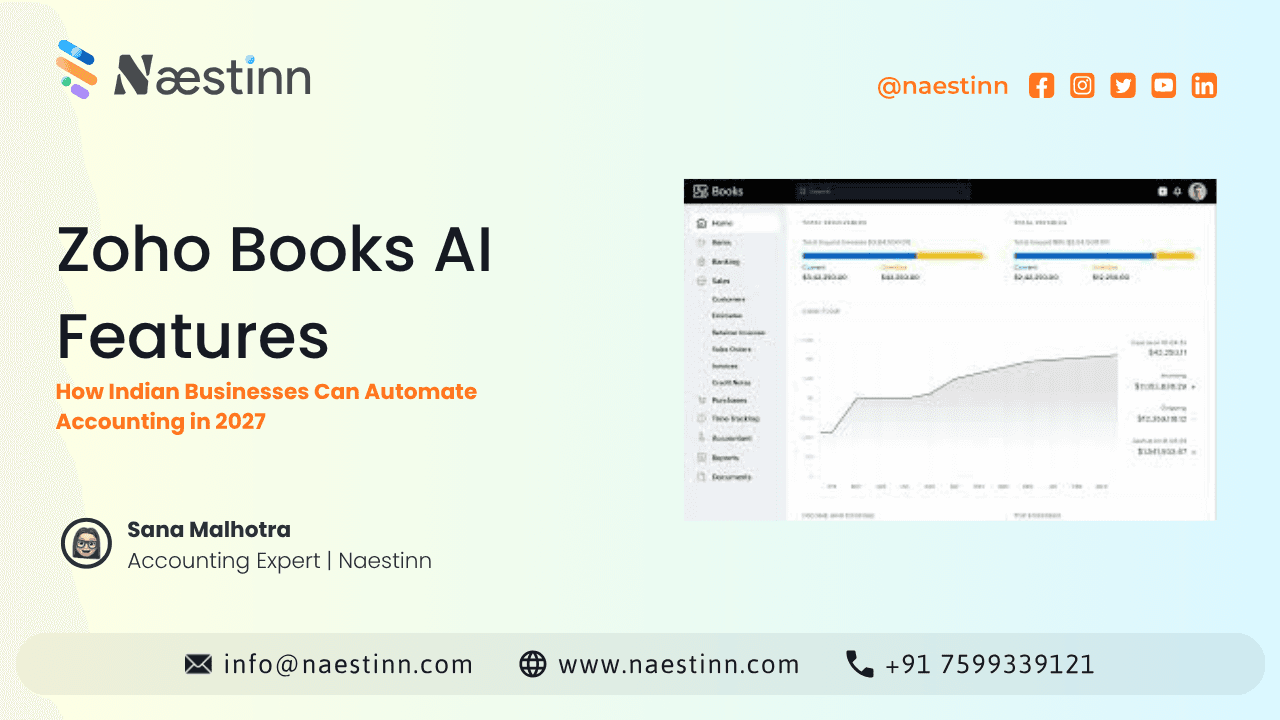
Accounting is changing.
Businesses are no longer looking only for software that records invoices, expenses and payments. They increasingly want systems that can reduce repetitive work, identify unusual financial activity, provide insights and help employees take action faster.
This is where AI-powered accounting becomes relevant.
For Indian businesses using Zoho Books, AI capabilities can support tasks such as asking questions about financial data, identifying anomalies, generating insights, automating collection activities, categorizing bank statements and creating certain workflows.
For manufacturing, automotive, trading and corporate businesses dealing with high transaction volumes, these capabilities can potentially reduce the amount of manual accounting work.
But what exactly can AI do inside Zoho Books?
Let's explore.
What Is AI-Powered Accounting?
Traditional accounting software primarily records and organizes financial transactions.
AI-powered accounting goes a step further.
Instead of requiring users to manually search through reports or perform every repetitive action, AI can help with tasks such as:
-
Finding information
-
Summarizing financial data
-
Identifying unusual patterns
-
Categorizing transactions
-
Generating emails
-
Automating repetitive workflows
-
Supporting collections
-
Creating reports or workflows from prompts
The objective isn't to replace accountants.
The goal is to reduce repetitive work and help finance teams spend more time on analysis and decision-making.
Why Indian Businesses Are Looking at AI Accounting in 2027
Businesses in India often manage a combination of:
-
GST
-
Invoices
-
E-invoices
-
E-way bills
-
Vendor bills
-
Payments
-
Bank transactions
-
Receivables
-
Payables
-
Inventory
-
Multiple GST registrations
Managing these manually can become increasingly difficult as a business grows.
Zoho Books supports Indian GST workflows, including GST filing, reconciliation and related compliance functionality.
It also supports e-invoicing workflows through integration with the Invoice Registration Portal (IRP).
Adding AI and automation capabilities can help businesses move from simply recording transactions toward more automated financial workflows.
1. Ask Zia Questions About Your Financial Data
One of the most interesting AI capabilities in Zoho Books is Ask Zia.
Instead of navigating through multiple reports, users can ask questions in plain language.
For example:
"What were our total sales last month?"
Or:
"Show me our outstanding receivables."
According to Zoho, Ask Zia can answer questions and provide links to take actions directly from the conversational interface.
This can make financial information easier to access for business owners and managers who don't want to manually navigate through multiple accounting screens.
2. Detect Unusual Financial Activity
Financial reports can contain hundreds or thousands of transactions.
Finding unusual changes manually isn't always easy.
Zoho Books' AI capabilities include anomaly detection, which uses machine learning to identify unusual spikes or drops in report data and indicate how they differ from expected values.
For example, an unusual change in:
-
Expenses
-
Revenue
-
Cash flow
-
Other financial metrics
could prompt the finance team to investigate further.
AI doesn't replace financial review, but it can help teams notice potential issues earlier.
3. Get AI-Powered Financial Insights
Numbers alone don't always tell the whole story.
Zoho Books includes Zia Insights, which can provide plain-language interpretations of reports.
This can be useful for business owners who want a quicker understanding of financial reports without manually interpreting every number.
For example, instead of only looking at a report, management can use AI-generated insights as an additional starting point for understanding what changed.
4. Forecast Revenue and Cash Flow
Another useful AI capability is forecasting.
Zoho Books provides AI forecasts that can give businesses a forward-looking view of metrics such as revenue and cash flow, including variance ranges for different scenarios.
This can help businesses think beyond:
"What happened last month?"
and start asking:
"What could happen next?"
For growing manufacturing or trading businesses, forward-looking financial visibility can be useful when planning purchases, expenses and cash requirements.
5. Automate Bank Transaction Categorization
Bank reconciliation can be one of those repetitive accounting activities that takes time every month.
Zoho Books uses AI to pre-fill categorization details for bank statement transactions based on available data.
Instead of manually entering every category from scratch, the system can assist with the categorization process.
The accountant can then review the suggested information before finalizing the transaction.
6. Automate Customer Collections
Getting invoices paid on time is important for cash flow.
Zoho Books' AI capabilities include an invoicing agent that can provide invoice summaries, risk flags and ready-to-send bulk reminders for collections.
This can be particularly useful for businesses managing a large number of outstanding invoices.
For example:
Invoice Generated → Payment Due → Reminder → Follow-Up → Collection
Instead of manually tracking every customer, automation can help make the process more systematic.
7. Generate Better Business Emails With AI
Finance teams frequently send emails for:
-
Payment reminders
-
Invoice communication
-
Customer follow-ups
-
Vendor communication
-
Internal updates
Zoho Books provides AI assistance for generating, refining and personalizing automated business email templates.
This can reduce the time spent writing repetitive financial communication.
8. Create Invoices and Other Documents Using Prompts
Zoho Books also provides AI-assisted creation capabilities.
With its CoCreate Agent, users can use prompts to create invoices, quotes, sales orders and credit notes, as well as customize certain reports.
This introduces a more conversational approach to accounting workflows.
Instead of navigating through multiple screens, users can describe what they want and then review the generated result.
9. Build Workflows With AI
Every business has its own approval and operational processes.
For example, a manufacturing company might have:
Purchase Request → Manager Approval → Purchase Order → Vendor Bill → Payment
A trading company could have:
Sales Order → Stock Check → Invoice → Payment → Collection
Zoho Books' AI capabilities include generating Blueprints from prompts for custom modules, mapping states, transitions and ownership.
This can help businesses design more structured workflows instead of relying entirely on manual follow-ups.
10. Use AI Custom Fields
Zoho Books also supports AI-powered custom fields that can use available data, uploaded images or other fields for tasks such as OCR, sentiment analysis, image descriptions and object detection.
This can open up interesting possibilities for businesses with industry-specific requirements.
For example, businesses may use document or image-based information as part of their internal workflows, depending on their configuration and use case.
AI + GST Automation: Where Indian Businesses Can Benefit
AI is only one part of accounting automation.
For Indian businesses, GST automation remains an important part of the overall workflow.
Zoho Books supports GST-related activities such as:
-
GST configuration
-
GST returns
-
GSTR-1
-
GSTR-3B
-
GSTR-9
-
GSTR-2B reconciliation
-
GST approvals
Zoho Books also supports e-invoicing workflows through the IRP, including generating IRNs and QR codes for eligible transactions.
So the bigger opportunity isn't just AI accounting.
It is:
Accounting + GST + Banking + Invoicing + Inventory + Automation + AI
working together in a connected system.
How Different Businesses Can Use Zoho Books AI
Manufacturing Companies
AI and automation can support:
-
Invoice processing
-
Payment follow-ups
-
Bank categorization
-
Financial insights
-
Expense monitoring
-
Purchase workflows
-
Reporting
Manufacturers with more complex production requirements may also need additional applications or integrations beyond accounting.
Automotive Businesses
Automotive businesses can use accounting automation for:
-
Customer invoicing
-
Dealer transactions
-
Payment tracking
-
Receivables
-
Expense management
-
Financial reporting
-
Automated follow-ups
Trading Businesses
Trading companies often handle large volumes of purchases, sales and customer payments.
Automation can help with:
-
Recurring invoices
-
Payment reminders
-
Bank categorization
-
Receivables
-
Purchase workflows
-
Inventory-related accounting processes
Corporate Businesses
Larger organizations may benefit from:
-
Approval workflows
-
Role-based access
-
Automated notifications
-
Financial dashboards
-
Multi-user collaboration
-
Integrations
-
Custom workflows
Zoho Books AI vs Traditional Accounting Processes
|
Traditional Process |
AI & Automation Approach |
|
Manually search reports |
Ask AI for information |
|
Manually identify unusual changes |
AI-assisted anomaly detection |
|
Manually categorize bank transactions |
AI-assisted categorization |
|
Manually write payment reminders |
AI-assisted email generation |
|
Manually monitor collections |
AI-supported collection workflows |
|
Manually build some workflows |
AI-assisted Blueprint creation |
|
Manually interpret every report |
AI-generated insights |
|
Manual recurring transactions |
Automated recurring transactions |
The purpose isn't to remove human oversight.
Instead, businesses can use AI to handle or assist with repetitive tasks while finance professionals remain responsible for reviewing important financial decisions.
Should Your Business Implement Zoho Books AI?
AI sounds attractive, but implementation should begin with your business processes, not the technology.
Before implementing Zoho Books, identify:
-
Which accounting tasks consume the most time?
-
Which processes are repetitive?
-
Where are errors occurring?
-
Which reports do managers regularly need?
-
How are invoices and payments currently managed?
-
How is GST handled?
-
What software does the business already use?
-
Does Zoho Books need to integrate with CRM or inventory systems?
-
Which workflows require approval?
-
Which processes should be automated first?
Once these questions are answered, you can determine where Zoho Books and its AI capabilities actually provide value.
Why Zoho Books Implementation Matters
Buying accounting software is only the beginning.
A business may have:
Zoho Books + CRM + Inventory + Website + Payment Systems + Internal Workflows
If these systems aren't configured properly, employees may continue using spreadsheets and manual processes.
A Zoho implementation partner can help businesses with:
-
Requirement analysis
-
Process mapping
-
Zoho Books configuration
-
Data migration
-
Workflow automation
-
Customization
-
Integrations
-
User training
-
Ongoing support
For manufacturing, automotive and trading businesses, this can be particularly important because accounting is often connected to sales, purchasing, inventory and operations.
Final Thoughts
AI-powered accounting is moving beyond simple automation.
With Zoho Books, businesses can use AI capabilities to ask questions, identify anomalies, generate insights, forecast financial metrics, categorize bank transactions, support collections and create workflows.
For Indian businesses, these capabilities can work alongside GST, e-invoicing, banking, invoicing and inventory functionality.
But AI shouldn't be implemented simply because it is the latest technology.
The real value comes when AI and automation are applied to the right business processes.
Looking to automate your accounting processes?
Naestinn can help businesses evaluate their accounting workflows and implement Zoho Books with automation, integrations and customized processes based on their business requirements.
Talk to Naestinn about your Zoho Books implementation requirements.
Frequently Asked Questions
What are the AI features in Zoho Books?
Can Zoho Books automate accounting?
Is Zoho Books suitable for Indian businesses?
Can Zoho Books help with GST compliance?
Can Zoho Books generate e-invoices?
Table of Contents
Tags
Top Stories


Turn your vision into
scalable reality.
Stop guessing with AI-generated scopes. Get reliable architecture, expert engineering, and a product that scales.