There’s a point in every growing sales team where tools stop feeling helpful.
You have a CRM.
You have dashboards.
You have reports everywhere.
But still, a simple question like:
“What should I focus on today?”
takes too long to answer.
That’s exactly where things started breaking for us.
We were using Zoho CRM every day, but instead of making decisions faster, we were spending time finding information.
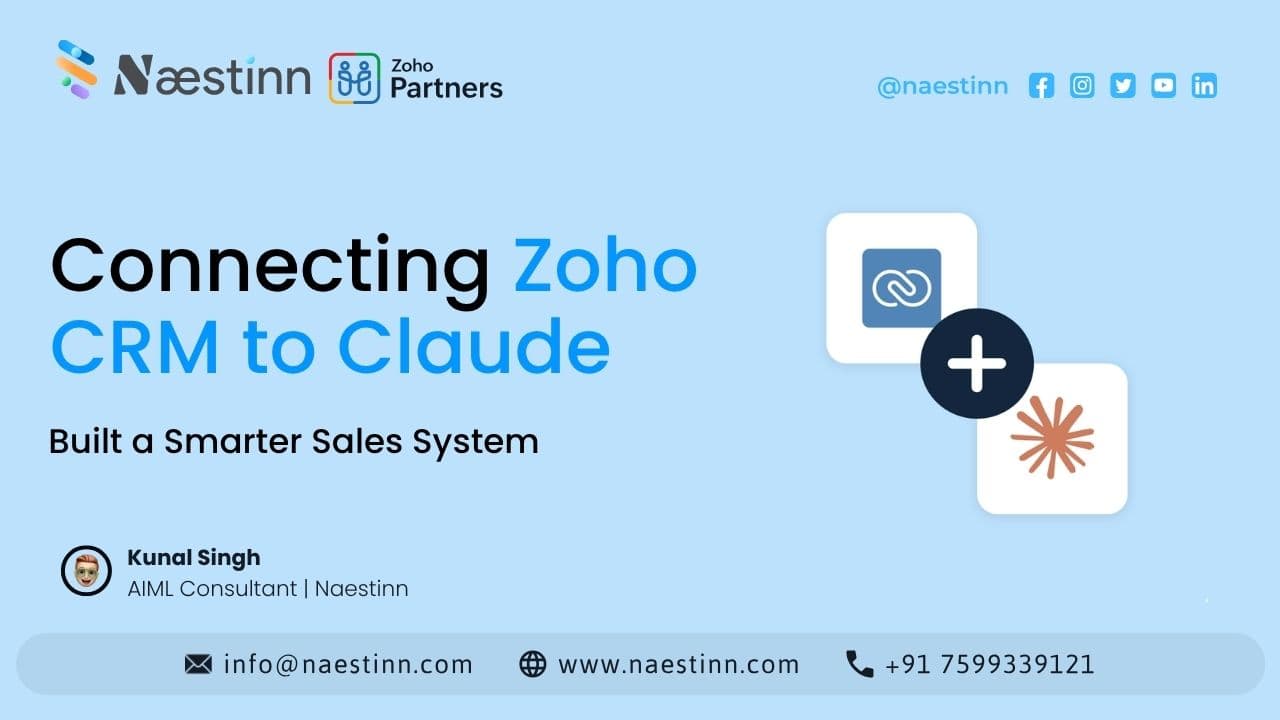
So we did something simple but powerful — we connected our CRM to Claude using an LLM layer, designed and structured with help from Naestinn.
That’s when everything changed.
The real problem wasn’t data — it was access
Our CRM already had everything:
-
leads
-
deals
-
pipeline stages
-
customer history
But none of it was instantly usable.
Every insight required:
-
filters
-
reports
-
exports
-
manual analysis
So even though data was available, answers were slow.
And in sales, slow answers mean slow decisions.
The shift: from clicking to asking
Once the integration went live, something interesting happened.
Instead of opening dashboards, we started asking questions like:
-
“Which deals are stuck and why?”
-
“What should I prioritize today?”
-
“Summarize my pipeline in simple terms”
And instead of navigating CRM screens, we got direct answers.
Not raw data.
Interpretation.
That changed how the entire sales team worked.
Where the 15+ hours actually came from
The time savings didn’t come from one big automation.
It came from eliminating hundreds of small friction points:
-
no more manual pipeline reports
-
no more filtering leads repeatedly
-
no more exporting Excel summaries
-
no more asking teammates for updates
-
no more dashboard hunting
Individually, these tasks feel small.
Together, they consume 15+ hours every week per team.
What Zoho CRM becomes with AI
With Zoho CRM connected to an LLM, the CRM stops being a static system.
It starts behaving like:
-
a sales analyst
-
a reporting assistant
-
a pipeline coach
-
a decision support system
Instead of asking:
“Where is the data?”
you ask:
“What does the data mean?”
Why implementation matters more than integration
This is where most teams go wrong.
Connecting AI to CRM is easy.
But making it:
-
secure
-
structured
-
scalable
-
useful for real sales teams
…is where expertise matters.
That’s why the system was designed with Naestinn, ensuring:
-
proper CRM data mapping
-
controlled AI access layers
-
workflow-safe automation
-
role-based data visibility
Without this layer, AI in CRM becomes noise instead of value.
What changed after implementation
Before:
-
dashboards everywhere
-
manual reporting
-
delayed insights
-
reactive sales approach
After:
-
instant answers
-
faster decision-making
-
proactive pipeline management
-
reduced operational load
But the biggest change wasn’t productivity.
It was clarity.
The most important insight
We didn’t realize how much time we were spending understanding our own CRM.
Once that friction disappeared, sales stopped feeling like administration.
And started feeling like actual selling again.
Where this is heading
This is just the beginning.
The next version of CRM systems will:
-
talk instead of display
-
suggest instead of wait
-
act instead of request
In that world, tools like Zoho CRM won’t just store business data.
They’ll explain it in real time.
Final thought
Connecting CRM to an LLM didn’t just improve efficiency.
It changed how decisions are made.
And with the right implementation partner , that shift becomes structured, secure, and scalable — not experimental.
Frequently Asked Questions
What happens when Zoho CRM is connected to Claude?
How much time can teams save using AI with CRM?
Can AI replace CRM dashboards?
What is the biggest benefit of CRM + AI integration?
Top Stories


Turn your vision into
scalable reality.
Stop guessing with AI-generated scopes. Get reliable architecture, expert engineering, and a product that scales.