Why SMEs Are Replacing Spreadsheets

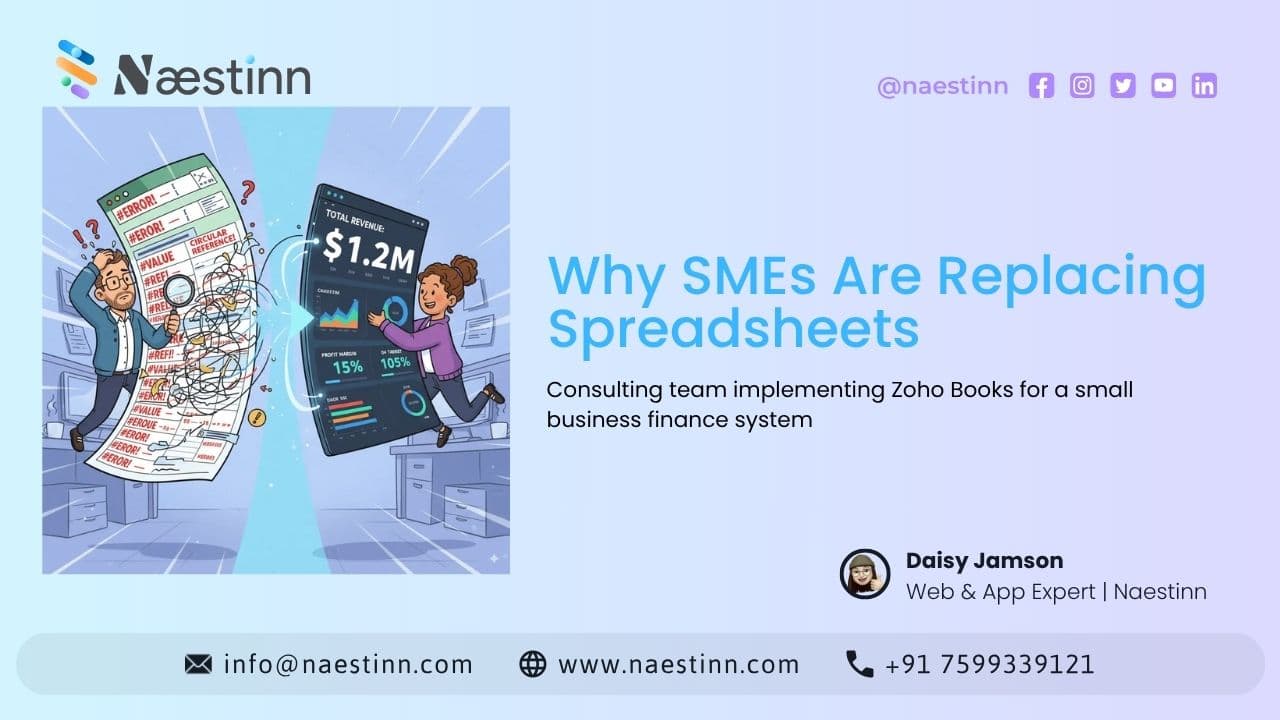
However, as businesses grow, spreadsheets begin to show limitations in accuracy, automation, collaboration, and real-time financial visibility.
Today, SMEs are rapidly shifting toward modern cloud accounting platforms like Zoho Books, which provide automation, scalability, and error-free financial management.
With support from implementation partners like Naestinn, businesses are successfully transitioning from manual systems to intelligent accounting workflows.
Problems with Spreadsheets in SME Accounting
1. High Risk of Human Errors
-
Formula mistakes
-
Manual entry errors
-
Duplicate records
-
Broken calculations
Even a small error can lead to financial misreporting.
2. Lack of Real-Time Financial Data
Spreadsheets are static:
-
No live updates
-
No centralized financial dashboard
-
Delayed decision-making
3. Poor Scalability
As SMEs grow:
-
Data becomes unmanageable
-
Multiple files are created
-
Version control becomes difficult
4. No Automation
Everything is manual:
-
Invoice creation
-
Expense tracking
-
Payment reminders
-
Report generation
5. Collaboration Issues
-
Multiple versions of files
-
No role-based access
-
No audit tracking
Why SMEs Are Moving to Zoho Books
1. Automation of Core Accounting Tasks
Zoho Books automates:
-
Invoicing
-
Expense tracking
-
Bank reconciliation
-
Recurring billing
-
Payment reminders
This reduces manual workload significantly.
2. Real-Time Financial Insights
SMEs can now:
-
Track cash flow instantly
-
Monitor profits and losses
-
View live dashboards
-
Make faster decisions
3. Error-Free Accounting System
Unlike spreadsheets:
-
No broken formulas
-
No manual calculations
-
Built-in validation rules
4. Cloud Accessibility
Zoho Books allows:
-
Access from anywhere
-
Multi-device support
-
Secure login systems
5. Better Compliance & Reporting
SMEs can generate:
-
GST reports
-
Financial statements
-
Tax summaries
-
Audit-ready reports
Role of Implementation Partners
Migrating from spreadsheets to accounting software is not just a tool switch—it is a process transformation.
This is where Naestinn plays a key role.
Naestinn helps SMEs:
-
Migrate spreadsheet data to Zoho Books
-
Set up accounting workflows
-
Configure automation rules
-
Train finance teams
-
Integrate Zoho with business systems
This ensures a smooth, error-free transition.
Spreadsheet vs Zoho Books (Quick Comparison)
|
Feature |
Spreadsheets |
Zoho Books |
|
Automation |
No |
Yes |
|
Error Risk |
High |
Very Low |
|
Real-time Data |
No |
Yes |
|
Reporting |
Manual |
Automated |
|
Scalability |
Poor |
High |
|
Collaboration |
Limited |
Advanced |
Why SMEs Prefer Cloud Accounting Today
1. Faster Growth Needs Better Systems
Manual tools slow down scaling.
2. Financial Accuracy Matters More
Errors in spreadsheets can impact business decisions.
3. Digital Transformation Pressure
Businesses are moving toward automation-first systems.
4. Cost Efficiency
Zoho Books reduces dependency on manual accountants for repetitive tasks.
Security Advantage of Zoho Books
SMEs also benefit from:
-
Encrypted financial data
-
Role-based access control
-
Secure cloud storage
-
Activity logs for transparency
Future of SME Accounting
The future is moving toward:
-
AI-powered bookkeeping
-
Automated tax filing
-
Predictive cash flow analysis
-
Smart financial alerts
Zoho Books is already building toward this ecosystem.
Conclusion
Spreadsheets once played a key role in SME accounting, but they are no longer sufficient for growing businesses.
Modern SMEs are adopting Zoho Books to improve accuracy, automation, and financial visibility.
With expert support from zoho partners, businesses can smoothly transition from manual systems to fully automated cloud accounting environments.
Frequently Asked Questions
Why are SMEs moving away from spreadsheets?
What are the main problems with using spreadsheets for accounting?
. How does Zoho Books improve accounting for SMEs?
Tags
Top Stories


Turn your vision into
scalable reality.
Stop guessing with AI-generated scopes. Get reliable architecture, expert engineering, and a product that scales.