Zoho Books: Advantages and Disadvantages You Should Know Before Choosing It

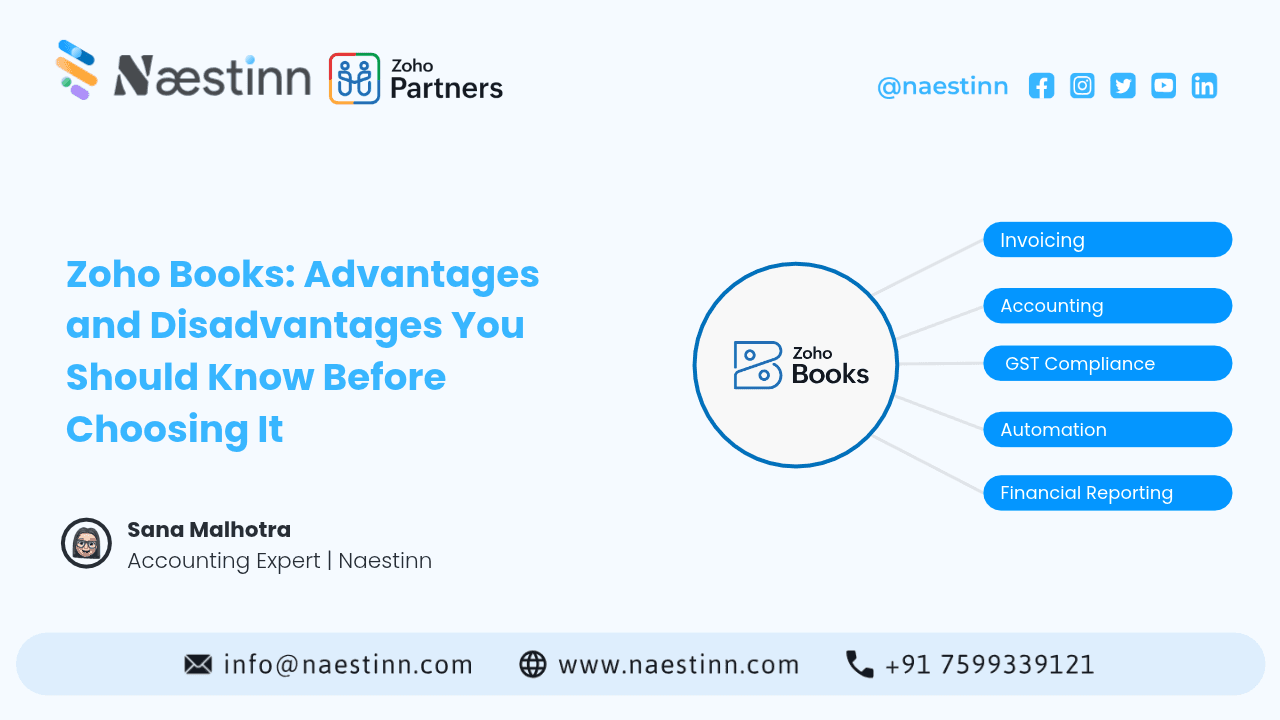
Zoho Books is a cloud-based accounting solution designed for businesses ranging from freelancers and startups to growing and established companies.
But is Zoho Books the right accounting software for every business?
Zoho Books offers features such as invoicing, expense management, bank reconciliation, inventory management, tax management, automation, reporting, and integrations with other business applications. At the same time, businesses should consider factors such as plan limitations, pricing, feature availability, and the learning curve before choosing it.
In this article, we explore the advantages and disadvantages of Zoho Books, who can benefit from it, and what businesses should consider before making a decision.
Introduction
Accounting is no longer limited to recording income and expenses in spreadsheets.
Modern businesses need accounting software that can help them manage invoices, payments, expenses, taxes, inventory, banking, and financial reports from one platform.
This is where Zoho Books comes in.
Zoho Books is an online accounting software that helps businesses manage their financial operations and automate several accounting-related tasks. It is also connected to the wider Zoho ecosystem, making it possible for businesses to connect accounting with CRM, inventory, payments, analytics, and other business processes.
However, choosing accounting software shouldn't be based only on the number of features it offers.
A business should also consider:
-
Pricing
-
Ease of use
-
Scalability
-
Integrations
-
Automation
-
Tax requirements
-
Reporting
-
Customer support
-
Business-specific requirements
So, let's look at the advantages and disadvantages of Zoho Books before you decide whether it fits your business.
What Is Zoho Books?
Zoho Books is a cloud-based accounting platform developed by Zoho.
It allows businesses to manage various financial activities from a centralized system, including:
-
Invoices
-
Estimates
-
Expenses
-
Bills
-
Customer payments
-
Vendor payments
-
Bank reconciliation
-
Inventory
-
Taxes
-
Financial reports
-
Recurring transactions
-
Accounting automation
Zoho Books is available through multiple subscription plans, including a free option for eligible businesses and paid plans with additional capabilities. The exact pricing and features depend on the country and selected plan.
For Indian businesses, Zoho Books also provides GST-related accounting functionality designed around Indian tax requirements.
Advantages of Zoho Books
1. Easy Online Accounting
One of the biggest advantages of Zoho Books is that it is cloud-based.
Instead of keeping accounting information on a single computer, businesses can access their financial information through the internet.
This can be useful for:
-
Remote teams
-
Business owners
-
Accountants
-
Finance teams
-
Multiple-location businesses
It also reduces the dependency on maintaining accounting software on individual computers.
2. Professional Invoicing
Zoho Books allows businesses to create and send professional invoices to customers.
Businesses can customize invoice information and track the status of invoices.
You can manage:
-
Draft invoices
-
Sent invoices
-
Paid invoices
-
Overdue invoices
-
Recurring invoices
This can make the invoicing process more organized than manually preparing invoices in spreadsheets or documents.
3. Expense Management
Tracking business expenses is essential for understanding where money is being spent.
Zoho Books allows businesses to record and categorize expenses.
For example, businesses can track expenses related to:
-
Office operations
-
Travel
-
Marketing
-
Software
-
Professional services
-
Purchases
This gives business owners better visibility into their spending.
4. Bank Reconciliation
Bank reconciliation is another useful accounting feature.
Businesses can connect their bank accounts and compare bank transactions with transactions recorded in their accounting system.
This can help identify:
-
Missing transactions
-
Duplicate entries
-
Incorrect records
-
Unmatched payments
Automating parts of this process can save finance teams time.
5. GST and Tax Management
For businesses in India, tax compliance is an important accounting requirement.
Zoho Books provides GST-related features such as GST invoices, tax reports, GST reconciliation, and support for multiple GSTINs depending on the plan and setup.
This can make Zoho Books particularly relevant for Indian businesses looking for accounting software with GST functionality.
However, businesses should always verify the latest tax features and compliance requirements before implementation.
6. Inventory Management
Businesses that sell physical products need more than just accounting.
They also need to know:
-
What products are available?
-
How much stock is left?
-
Which products are selling?
-
What inventory needs to be reordered?
Zoho Books provides inventory-related functionality on applicable plans.
This can help businesses connect sales and accounting with inventory management rather than maintaining completely separate records.
7. Automation
Manual accounting tasks can consume a significant amount of time.
Zoho Books supports automation for various activities, depending on the plan.
Businesses can automate tasks such as:
-
Recurring invoices
-
Payment reminders
-
Workflow-based actions
-
Scheduled reports
-
Repetitive transactions
For growing businesses, automation can reduce repetitive administrative work.
8. Financial Reporting
Business owners need more than a list of transactions.
They need to understand the financial health of their business.
Zoho Books provides financial reports that can help businesses monitor areas such as:
-
Revenue
-
Expenses
-
Profit and loss
-
Receivables
-
Payables
-
Cash flow
-
Taxes
Higher plans can provide access to additional reporting and analytics capabilities.
9. Integration With Other Zoho Applications
One of the strongest advantages of Zoho Books is its connection to the broader Zoho ecosystem.
For example, a business can potentially connect:
Zoho CRM → Zoho Books → Zoho Inventory → Zoho Analytics
This can help connect different parts of the business.
For example:
A sales team creates a customer in CRM → customer information moves into the accounting workflow → invoices are created → payments are recorded → financial data can be analyzed.
The exact integration capabilities depend on the applications and subscription plans being used.
10. Multiple Pricing Options
Zoho Books offers different plans for different business requirements.
This allows businesses to start with a plan that matches their current needs and upgrade as their requirements increase.
For example:
Small business → Basic requirements
Growing business → More users and automation
Established business → Advanced accounting, inventory and reporting
This makes the platform more flexible for businesses at different stages.
Disadvantages of Zoho Books
Zoho Books has several advantages, but it isn't automatically the right choice for every business.
Here are some factors to consider.
1. Some Features Are Plan-Dependent
One of the most important things to understand is that not every feature is available on every plan.
Some advanced features may require a higher subscription.
For example, businesses may need to upgrade for additional:
-
Users
-
Transaction limits
-
Automation
-
Inventory functionality
-
Reporting
-
Customization
-
Advanced controls
Therefore, businesses should compare plans carefully rather than selecting the cheapest option based only on price.
2. Learning Curve for Advanced Features
Basic activities such as creating an invoice can be relatively straightforward.
However, things can become more complicated when businesses start using:
-
Advanced workflows
-
Automation
-
Integrations
-
Inventory
-
Customization
-
Complex accounting processes
Businesses may require training or implementation support to configure the system correctly.
3. Pricing Can Increase as the Business Grows
The entry-level pricing may look attractive, but businesses should consider their long-term requirements.
As the business grows, it may require:
-
More users
-
More automation
-
Additional storage
-
Advanced features
-
More integrations
This can increase the overall software cost.
Therefore, businesses should calculate the total expected cost based on future requirements, not just the starting subscription price.
4. Advanced Requirements May Need Customization
Every business has its own accounting processes.
Some companies may need custom workflows, specialized reports, integrations, or specific approval processes.
While Zoho Books provides customization options, businesses with complex requirements may need professional implementation or development support.
This is particularly relevant when Zoho Books needs to connect with other software used by the company.
5. Migration Requires Planning
Moving from another accounting platform to Zoho Books isn't simply a matter of creating an account.
Businesses may have years of:
-
Customer data
-
Vendor records
-
Invoices
-
Bills
-
Payments
-
Bank transactions
-
Accounting records
A poorly planned migration can result in data inconsistencies or operational problems.
Businesses moving from platforms such as Tally, QuickBooks, Excel, or other accounting systems should plan their migration carefully.
Zoho Books: Advantages vs Disadvantages
|
Advantages |
Disadvantages |
|
Cloud-based accounting |
Some features are plan-dependent |
|
Professional invoicing |
Advanced features may require higher plans |
|
Expense management |
Learning curve for advanced functionality |
|
Bank reconciliation |
Costs can increase as requirements grow |
|
GST-related functionality |
Complex setups may require implementation support |
|
Inventory management |
Migration requires planning |
|
Automation |
Custom requirements may need additional work |
|
Financial reporting |
— |
|
Zoho ecosystem integrations |
— |
|
Multiple subscription options |
— |
Who Should Consider Zoho Books?
Zoho Books can be considered by businesses such as:
-
Startups
Startups looking for structured accounting software without immediately investing in a complex enterprise accounting system can evaluate Zoho Books.
-
Small Businesses
Businesses with invoicing, expense tracking, banking, and tax requirements can use Zoho Books to centralize their accounting.
-
Service Businesses
Agencies, consultants, IT companies, and professional service providers can use features such as invoicing, expenses, payments, and customer management.
-
Product-Based Businesses
Businesses selling physical products can consider Zoho Books if they need accounting and inventory functionality.
-
Businesses Already Using Zoho
Companies already using Zoho CRM or other Zoho applications may find value in connecting their accounting system to the broader Zoho ecosystem.
What Should You Check Before Choosing Zoho Books?
Before subscribing, don't simply ask:
"Is Zoho Books good?"
Instead, ask whether it fits your business requirements.
Check:
1. Your monthly transaction volume
How many invoices, bills, expenses, and payments do you process?
2. Number of users
Who needs access to the accounting system?
3. Tax requirements
Do you need GST or other country-specific tax features?
4. Inventory requirements
Do you sell products or only provide services?
5. Automation requirements
Which repetitive accounting processes do you want to automate?
6. Integration requirements
Do you need to connect Zoho Books with CRM, ecommerce platforms, payment gateways, or other business software?
7. Migration requirements
Are you moving from another accounting system?
8. Future growth
Will your current plan still work when your business doubles or triples in size?
Is Zoho Books Worth Considering?
Zoho Books can be a suitable accounting solution for businesses that want cloud-based accounting, invoicing, expense management, tax functionality, automation, reporting, and integration with a wider business software ecosystem.
Its biggest advantages include its broad accounting functionality, multiple plans, automation capabilities, and integration possibilities.
However, businesses should also consider plan restrictions, future costs, implementation requirements, migration complexity, and their specific accounting workflows before choosing it.
The right accounting software depends on the business—not simply the number of features a platform offers.
Conclusion
Zoho Books has several advantages, but it isn't a one-size-fits-all accounting solution.
For startups, small businesses, service companies, product-based businesses, and organizations already using Zoho applications, it can provide a centralized way to manage accounting and financial operations.
At the same time, businesses with complex requirements should carefully evaluate the available plans, integrations, customization options, migration requirements, and total cost.
Before making a decision, create a simple checklist of your requirements:
Accounting + Tax + Invoicing + Inventory + Automation + Integrations + Reporting + Budget
Then compare those requirements against the Zoho Books plan you are considering.
Need Help With Zoho Books?
Choosing the right plan is only the first step. Implementation, customization, migration, integrations, and ongoing support can also determine how effectively your business uses Zoho Books.
Naestinn helps businesses with Zoho implementation, customization, integration, and support. If you're planning to adopt Zoho Books or move from another accounting platform, you can discuss your business requirements with the Naestinn team and evaluate the right setup for your organization.
Frequently Asked Questions
Top Stories



Turn your vision into
scalable reality.
Stop guessing with AI-generated scopes. Get reliable architecture, expert engineering, and a product that scales.