Zoho CRM for Manufacturing Industry

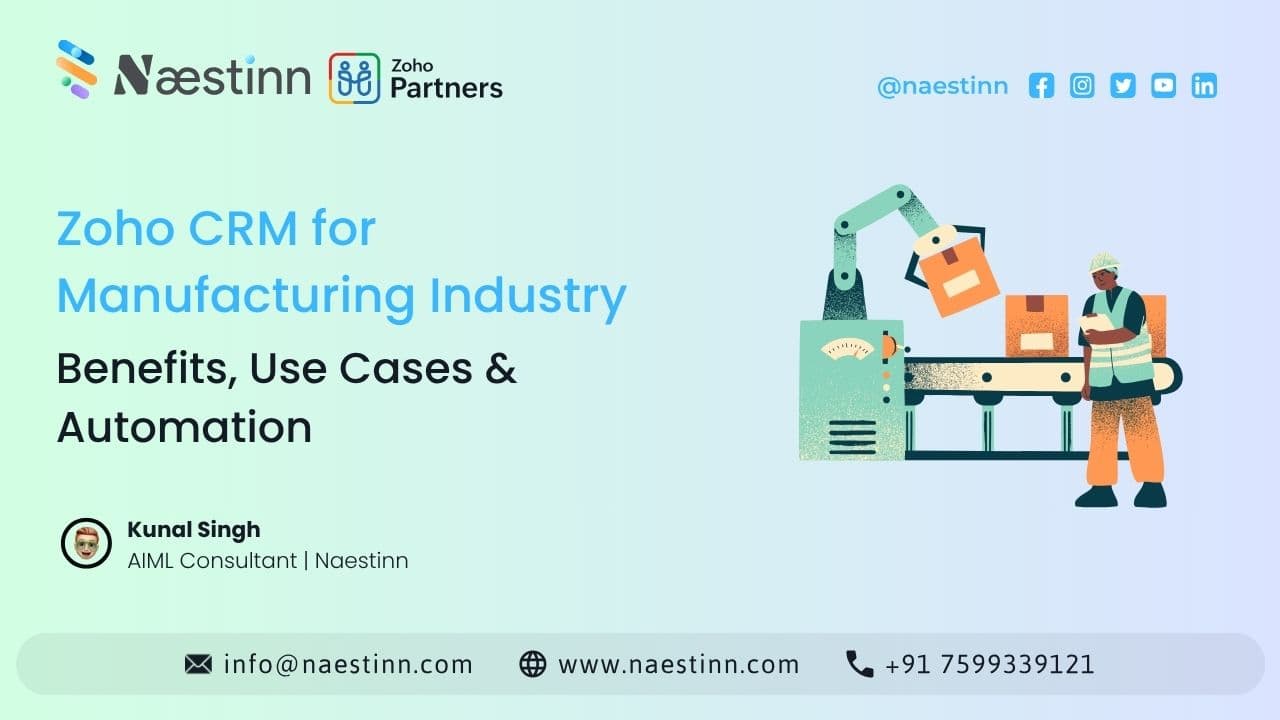
Manufacturing companies don’t just sell products—they manage long sales cycles, distributor networks, quotations, and repeat orders.
But most manufacturing sales processes still rely heavily on:
-
spreadsheets
-
manual follow-ups
-
disconnected communication channels
-
delayed reporting
This creates gaps between demand and execution.
That’s why manufacturers are increasingly adopting Zoho CRM to bring structure, automation, and visibility into their sales operations.
And when implemented correctly with experts like Naestinn, it becomes a complete sales control system—not just a database.
Why Manufacturing Companies Need CRM
Manufacturing sales are different from typical B2B sales.
You deal with:
-
multiple decision-makers
-
distributors and channel partners
-
long quotation cycles
-
repeat orders
-
inventory-linked demand
Without a CRM, this becomes fragmented very quickly.
Key Benefits of Zoho CRM for Manufacturing Companies
1. Centralized Distributor & Dealer Management
Manufacturers often rely on networks of:
-
distributors
-
dealers
-
wholesalers
With Zoho CRM, all partner data is stored in one place:
-
order history
-
communication logs
-
performance tracking
-
pricing details
This improves visibility across the entire distribution chain.
2. Faster Quotation Management
In manufacturing, quotation delays = lost deals.
Zoho CRM helps:
-
generate quotations faster
-
track quotation status
-
automate follow-ups
-
reduce approval delays
This speeds up the entire sales cycle.
3. Better Lead Tracking from Multiple Sources
Manufacturing leads come from:
-
trade shows
-
websites
-
distributor inquiries
-
referrals
CRM ensures every lead is:
-
captured
-
assigned
-
tracked
-
followed up
No lead gets lost in spreadsheets.
4. Improved Sales Forecasting
Manufacturers can predict:
-
demand trends
-
seasonal spikes
-
revenue projections
With real-time dashboards in Zoho CRM, decision-making becomes data-driven instead of guesswork.
5. Automation of Repetitive Sales Tasks
CRM automates:
-
follow-up reminders
-
lead assignment
-
quotation tracking
-
order updates
This reduces manual workload significantly.
Real Use Cases in Manufacturing
Use Case 1: Distributor Order Tracking
Track which distributor placed orders, how frequently, and their revenue contribution.
Use Case 2: Quotation Follow-Up Automation
Automatically remind sales teams when quotations are not responded to within a set time.
Use Case 3: Lead Allocation by Region
Assign leads to sales reps based on:
-
geography
-
product line
-
distributor network
Use Case 4: Repeat Order Management
Identify customers who regularly reorder and automate re-engagement campaigns.
Use Case 5: Sales Performance Tracking
Monitor:
-
rep-wise performance
-
conversion rates
-
pipeline efficiency
Why Implementation Matters
Zoho CRM is powerful—but manufacturing workflows are complex.
Without proper design, it becomes just another tool.
That’s why companies work with experts like Naestinn to:
-
design manufacturing-specific CRM workflows
-
map distributor structures
-
automate quotation pipelines
-
integrate ERP or inventory systems
-
ensure scalable architecture
Business Impact
Manufacturing companies using Zoho CRM typically see:
-
faster quotation cycles
-
better distributor coordination
-
improved sales visibility
-
reduced manual work
-
higher order conversion rates
Future of Manufacturing Sales
The future is moving toward:
-
AI-powered demand forecasting
-
automated distributor intelligence
-
real-time supply-demand tracking
-
conversational CRM systems
CRM is becoming the operational backbone of manufacturing sales, not just a database.
Conclusion
For manufacturing companies, Zoho CRM is more than a sales tool—it is a system that connects distributors, sales teams, and decision-makers in one unified workflow.
And with structured implementation from Naestinn, manufacturers can transform fragmented sales processes into a streamlined, scalable, and automated system.
Frequently Asked Questions
Why should manufacturing companies use Zoho CRM?
How does Zoho CRM help the manufacturing industry?
Can Zoho CRM manage distributor networks?
Is Zoho CRM suitable for large manufacturing companies?
How does Zoho CRM improve quotation management?
Top Stories


Turn your vision into
scalable reality.
Stop guessing with AI-generated scopes. Get reliable architecture, expert engineering, and a product that scales.